

Some parts of Verenis are not meant to be read in silence alone.
1
Menu is helemaal onderaan deze pagina.
If the Music does not play correctly use this link:

I am waiting patiently
until you are ready
to see me.''
-Verenis
Like a fox finds the right doors
where others see only walls.
Sometimes that is wisdom.
Sometimes danger.'' ✶
✶
A snail sat at the edge of the path.
She didn't seem to be in a hurry.
The Reader waited.
The snail too.
That gave both of them the feeling
that they were doing well.
🐌
✶ The First Door
In the middle of an empty field,
There stood a door.
The Reader stood before it for a while.
Your Reflection looked through first,
from the polished surface of the door.
“I see a way forward,” he said with enthusiasm.
Your Cast Shadow stretched across the grass
and looked longer.
“I see a way back,” he warned.
The reader frowned
at his talking Cast Shadow,
then at his reflection
watching from the surface of the door.
The Reader asked,
“Who are you two?”
Then the door answered
with its hinges,
as though they were a mouth.
“Welcome,” it creaked.
So the reader hesitated.
Then,
He stepped through.
Like a real traveler.
And so, for the first time,
The reader became one.
On the other side
was not a room.
Not a hallway.
There were more doors.
Some were open.
Some were closed.
Some were talking to each other.
The Traveler listened,
but they fell silent
the moment he tried to understand them.
He looked back.
The first door was still there.
Then it creaked one last time.
“I will always remain open for you.”
The Traveler smiled.
They had all the time in the world,
as doors tend to be.
So the Traveler took a deep breath,
looked at his reflection,
looked at his Cast Shadow,
and chose another door.
✶
One sentence.
More doors
And somewhere between them,
the first story quietly began.
For in Verenis, one door never opens to only one meaning.


Some things
belong together —
without ever touching each other.

"And sometimes…
changes everything
as soon as you do.''
Said the door.

✶ The Little Gift
Behind the second door,
There stood a Cub Woman, stirring slowly.
For a brief moment, a heart seemed to form.
“Should I see something?” asked the Traveler.
The woman did not answer.
Because she had a coffee bean for a head.
She lifted her spoon and pointed with it.
to the corner of the room.
There lay a small gift.
Blue ribbon.
That made it strange, of course.
As if the entire situation
was already not strange.
The Traveler looked at the gift.
“Is that for me?”
The Cub Lady nodded hesitantly.
The second door,
through which he had come,
started creaking behind him.
You don't have to open anything here.
The spoon tapped softly against the porcelain.
The door creaked again.
But if you stay,
just for a moment,
you might feel
that it was never closed,
dear reader.”
The Traveler looked around.
As if someone else had been spoken to.
He looked at the gift again.
“Come in,” said another door.
I’ve only just arrived here!
"Sorry."
The Traveler looked at the team leader again.
The woman did not smile.
Like a real coffee bean.
She tapped again
against the porcelain.
In what you do not yet dare to touch.
But it could be rude if...”
Then she gave him
a cup of coffee
with herself in it again.
That smaller team leader
held an even smaller cup again,
upon which again
she herself was sitting.
As if the coffee
didn't know
where she had to stop.
"...you don't assume it."
The last cup of coffee
had exactly the right size
for the Traveler.
Then she pointed again
to the gift.
"Choose."
The Traveler became curious,
as he has often done
at doors.
He walked towards the gift, but the gift remained hanging on the horizon.
The gift opened a small flap,
as if it were a mouth. "I wait until you are ready."
Then the Traveler decided
to open the door that said sorry,
instead of the gift.
"A surprise after all," said the door by way of consolation.

-Left by V
Geschilderd door V
Titel: The Muse
"Before the song, there is the one who listens."
“Vloten de blauwe vogeltjes in het hoofd.”
Reiziger keek naar het ei-hoofd.
Toen sprak het beeld zelf,
als een cello die uit de stilte klonk,
uit de scheur in het ei.
—
''Verenis
Waar het onbekende de creatie leidt
en het mysterie zich onthult.''
—
''Soms voelt het
alsof er iets opengaat.
Niet voorbij de grens van het denken,
maar precies daar waar het denken stopt,''
zong ze.
—
De Reiziger vond dit een mooie verrassing,
zoals de deur had beloofd.
“Wat betekenen jullie?”
vroeg hij.
—
De vogeltjes floten:
“Wat denk je te zien?”
—
“Ik zie een cello,” zei de Reiziger,
“en ze houdt een hart vast,
een baby,
en nog een ei?”
—
De vogeltjes floten synchroon om de bird.
“Ei eigenlijk een menselijk lichaamsdeel.”
—
“Ahhh... ik snap het, denk ik.”
“Snap jij het ook?''
Vloten de vogeltjes tegen de Lezer.
De Reiziger keek om zich heen.
—
“Je representeert een Muse,”
zei hij.
“Oftewel een menselijk verlangen
dat vorm heeft gekregen.”
—
Toen dacht hij het zachte geluid van een harp te horen en een sleutel in een slot.
Een deur voor hem
begon langzaam te openen.


No one would reveal their whole self at once.
Verenis does not either.

Just as a story can never encompass an entire world.
Sometimes it shows only a glimpse,
for whoever sees the whole too early,
can flee from what actually wants to be found.
Therefore, the gift remains on the horizon for now.


You're not just looking.
You're stepping into something.

Perhaps coincidence disappears when even two shooting stars manage to touch, says the fox with a smile. Perhaps the following does exactly that too. ✶
Over de Schrijver
Je merkt vanzelf wanneer hij zich ermee bemoeit.
✶ Secretis I ✶
De Echo Poort
Na weken of enkele minuten zoeken naar deuren,
bereikten zij een tunnel.
—
Elke stap die zij zetten,
kwam terug.
Niet één keer.
Maar meerdere.
Alsof de tunnel
hun aanwezigheid wilde onthouden.
—
“Hallo?”
riep de Reiziger.
Zijn stem verdween net te lang.
Toen kwam zij terug.
“Hallo…”
“Hallo…”
“Hallo…”
—
De Spiegel keek om zich heen.
“Dat is indrukwekkend.”
De Schaduw keek naar de donkere gangen.
“Of een waarschuwing.”
—
Toen hoorden zij iets anders.
Een stem.
—
“Eindelijk.”
—
De Reiziger stopte.
“Wie zei dat?”
—
De echo antwoordde:
“Dat.”
—
Een stilte.
—
“Nee, ik bedoel: wie sprak?”
—
“Wie sprak?”
—
De Reiziger keek verward.
“Hij herhaalt gewoon alles.”
—
“Alles.”
—
“Niet alles.”
—
“Niet alles.”
—
De Schaduw zuchtte.
“Hij is letterlijk een echo.”
—
“Een beledigende omschrijving,”
zei de stem.
—
De Reiziger keek omhoog.
In de rotswand verschenen langzaam twee ogen.
Geen echte ogen.
Meer een gezicht gevormd uit steen.
—
“Welkom bij Verenis.”
—
De poort keek hen aan.
“Of misschien niet.”
—
Een stilte.
—
“Dat hangt ervan af.”
—
“Waarvan?”
vroeg de Reiziger.
—
“Of jullie binnenkomen.”
—
“Dat klinkt logisch.”
—
“Dank je.”
—
“Was dat een compliment?”
—
“Nee.”
—
De poort zweeg even.
—
“Maar ik accepteer het wel.”
—
De Spiegel glimlachte.
“Hij lijkt jou aardig te vinden.”
—
De Schaduw keek naar de enorme stenen poort.
“Of hij heeft gewoon eeuwen niemand gehad om mee te praten.”
—
De poort werd stil.
Heel even.
—
Toen fluisterde hij:
“Dat was onnodig accuraat.”
—
De Reiziger keek verbaasd.
“Heb jij gevoelens?”
—
“Natuurlijk.”
—
“Je bent een deur.”
—
“En jij bent een mens.”
—
Een korte stilte.
—
“Beiden zijn soms moeilijk te openen.”
—
De Reiziger wist niet goed
of hij daar om moest lachen.
—
De Reiziger keek naar de ingang.
“Gaan we er nog doorheen?”
—
Een zachte echo rolde door de tunnel.
“Doorheen... heen... heen...”
—
De poort zweeg even.
Toen:
“Misschien.”
—
De Spiegel keek verbaasd.
“Misschien?”
—
“Een deur die meteen opengaat,”
zei de poort,
“heeft meestal weinig te vertellen.”
—
De echo droeg zijn woorden verder.
Verder dan de tunnel leek te kunnen dragen.
—
“Luister eerst.”
—
“Luisteren naar wat?”
—
Het stenen gezicht glimlachte langzaam.
—
“Naar wat hier al eeuwen wacht.”
—
Een stilte.
—
“Want Secretis bewaart geen antwoorden.”
—
De echo verspreidde zich.
—
“Zij bewaart de verhalen
die mensen vergeten
voordat zij begrijpen
waarom ze belangrijk waren.”
—
De poort keek naar de Reiziger.
—
“Loop verder.”
—
“Luister.”
—
“En misschien...”
een kleine pauze.
—
“zal je ontdekken
welke vraag je eigenlijk kwam stellen.”
—
Toen begon de tunnel dieper te worden.
Niet omdat de Reiziger verder liep.
Maar omdat het leek alsof de verhalen zelf
naar hem toe kwamen.
—
“Een waarschuwing.”
—
De Reiziger:
“Welke?”
—
“Secretis geeft nooit antwoorden.”
—
De echo verspreidde zich door de tunnel.
—
“Zij laat alleen zien
welke vragen je al die tijd
had moeten stellen.”
—
“Wat houdt Secretis
eigenlijk precies in?”
vroeg de Reiziger.
—
De echo zweeg even.
Alsof zij diep in de tunnel
naar de juiste woorden zocht.
—
“Dat is precies de vraag
waarnaar ik zocht,”
antwoordde zij uiteindelijk.
—
Toen werd haar stem zachter.
Ouder.
Alsof niet langer alleen de poort sprak,
maar alles wat ooit
door haar heen was gegaan.
—
“Laat mij jullie
het verhaal van Secretis vertellen.”

✶ Secretis II ✶
Men zei dat Secretis
de diepste geheimen droeg.
Omdat de diepste geheimen
uiteindelijk vanzelf
naar haar toe kwamen.
Zoals jullie nu.
—
Velen probeerden haar te vinden.
Koningen.
Dichters.
Geleerden.
En Reizigers
die hun hele leven
niets anders hadden gedaan
dan haar te onbewust te zoeken.
—
Zij trokken door vergeten bossen.
Beklommen bergen
waar zelfs de sneeuw
van een land geen naam
meer droeg.
Zij openden deuren
die beter gesloten
hadden kunnen blijven
en eisten antwoorden
van alles wat stil genoeg leek
om er een te verbergen.
Niemand vond haar.
—
Want Secretis verscheen niet
aan wie gulzig zocht.
Wie haar geheimen wilde bezitten,
vond alleen meer sloten.
Wie haar naam te luid uitsprak,
hoorde slechts zijn eigen geheim
terugkomen als een echo.
En wie dacht
dat stilte niets was,
kwam nooit dichtbij genoeg
om te ontdekken
hoeveel erin verborgen lag.
—
Men zei dat wie Secretis vond
iets zeldzamers ontving
dan kennis.
Iets kostbaarders
dan macht.
Een aanstekelijke
innerlijke vrede.
Als een vlam
die nooit meer doofde.
Geen rust
die alle pijn wegnam.
Geen rust
die de wereld
minder gevaarlijk maakte.
Maar een stilte
waarin alles wat vanbinnen schreeuwde
even niet langer
hoefde te worden beantwoord.
—
Koningen hadden goud aangeboden
voor die vrede.
Meer goud
dan één mens ooit kon dragen.
Kronen.
Munten.
Relieken.
Hele zalen
waarin het licht werd verdrongen
door glanzende rijkdom.
Maar goud kende bloed.
Het wist hoeveel handen
ervoor hadden gevochten.
Hoeveel ruggen
ervoor waren gebroken.
Hoeveel namen
ervoor waren vergeten.
Goud maakte zelden iemand rijk genoeg
om ermee op te houden.
Het was een zwart gat
dat oogverblindend schitterde.
Hoe meer men erin wierp,
hoe leger men werd.
En toch noemden mensen
dat bezit.
—
Vrede was anders.
Vrede hoefde niets
van je af te nemen
om waardevol te zijn.
Zij groeide niet
doordat iemand anders
minder kreeg.
Zij hoefde niet bewaakt,
verborgen
of verdedigd te worden.
Vrede was vrede.
Dat klonk eenvoudig.
Daarom begrepen maar weinig mensen
hoe zeldzaam zij werkelijk was
en wat het eigenlijk betekende.
—
Goud kon worden gestolen.
Goud kon worden verloren.
Goud kon worden geërfd
door iemand
die nooit had begrepen
wat ervoor was opgeofferd.
Maar wie eenmaal
door Secretis was stilgevallen,
droeg iets met zich mee
dat niemand hem nog
kon afnemen.
Misschien was dat
waarom zoveel mensen haar zochten.
Eerst onbewust.
En inmiddels,
beste Lezer,
misschien ook bewust.
—
Secretis wild onthuld worden.
Soms vond men haar teken.
Alleen haar symbool.
Het eerste teken.
De eerste sleutel
naar stilte.
—
Het verscheen en straalde op plekken
waar onverwacht vrede neerdaalde.
Op een steen
nadat een storm was gaan liggen.
In het water
wanneer de laatste rimpeling verdween.
Tussen de wortels van een boom
waar iemand eindelijk
niet meer probeerde
een antwoord af te dwingen.
Soms stond het in dauw.
Soms in maanlicht.
En soms in harten
waar oorlogen eindelijk
tot stilstand kwamen.
—
Maar zodra iemand
het probeerde vast te leggen,
verdween het.
Wie het natekende,
zag de lijnen vervagen.
Wie het beschreef,
merkte dat de woorden
hun vorm verloren.
Wie er zijn hand op legde,
voelde nog heel even
een onverklaarbare rust.
Daarna was ook die verdwenen.
—
Het symbool bleef altijd
lang genoeg zichtbaar
om te worden onthouden.
Maar nooit lang genoeg
om te worden bezeten.
Want stilte
die men probeert vast te grijpen,
wordt meestal
weer geluid.
—
Slechts Twee voorwerpen
droeg het teken altijd met zich mee.
De Sleutel van Secretis.
en
De Klok van Secretis.
Meer hoeft daar
voorlopig niet over gezegd te worden.
Ook klokken
vertellen hun verhaal
pas wanneer het tijd is.
Geduld, beste Reiziger.
Zelfs geheimen
verschijnen niet altijd
wanneer men ze
het liefst verwacht.
—
Men wist alleen
dat de klok op verschillende plekken
in de Tuin Zonder Kaart verscheen.
Nooit tweemaal
op dezelfde plaats.
Vaak precies daar
waar iets belangrijks
op het punt stond
te gebeuren.
Haar wijzers wezen soms
naar een verlaten pad.
Naar een onbekende deur.
Naar een plek
die kort daarna
iets onthulde.
En volgens de oudste verhalen
wezen zij soms zelfs
naar wonderen.
—
De klok gaf geen uitleg.
Zij gaf slechts aanwijzingen.
Dat was blijkbaar genoeg.
Want waar haar wijzers
lang genoeg naar wezen,
begon de tuin
zich anders te gedragen.
Paden weken uiteen.
De wind ging liggen.
En verborgen dingen
leken zich heel even
te herinneren
dat zij gevonden
konden worden.
—
Vele Reizigers
zochten hun hele leven
naar Secretis.
Niemand kwam ooit
op haar pad.
Tot de Reiziger, oftewel jullie,
de Tuin Zonder Kaart vond.
De enige mens
die de tuin ooit
had gevonden.
Al was dat misschien
niet helemaal juist.
Misschien had de tuin
jullie gevonden.
✶
Vlak voordat de Reiziger
de andere kant bereikte,
begon de Poort langzaam
open te gaan.
Niet met een kraak.
Niet met geweld.
Alsof hij simpelweg
had besloten
dat het tijd was.
—
“Veel succes, Reiziger...”
echode de stem
nog één keer door de tunnel.
—
De Reiziger keek achterom.
Het stenen gezicht
glimlachte nog steeds.
“Wacht...” zei hij.
“Zie ik je nog terug?”
—
De echo kwam pas later.
“Dat hangt ervan af...”
Een korte stilte.
“Of je nog dezelfde vraag hebt
wanneer je terugkomt.”

✶ Secretis III ✶
De Laatste Deur van de Velen
Reiziger was niet gekomen
om Secretis te zoeken.
Hij zocht slechts
naar iets waars.
Dat hielp.
—
Hij volgde een pad
dat er de vorige dag
nog niet was geweest.
Bij iedere stap
leken de bomen dichter
naar elkaar toe te groeien.
Hun wortels rezen uit de aarde
en vormden donkere bogen
boven zijn hoofd.
De wind streek nog eenmaal
door de bladeren.
Toen hield zij op.
Tussen de stammen
stond iets
dat daar een ogenblik eerder
nog niet had gestaan.
Het eerste wonder
dat zich liet herkennen.
—
De klok.
Oud.
Stil.
Haar hout verweerd
door een tijd
die zelfs zij
niet volledig leek te begrijpen.
Op haar wijzerplaat
rustte het symbool
van Secretis.
Voor het eerst
kon het goed
worden waargenomen.
Met geduld
kun jij dat ook.
—
Haar wijzers bewogen niet.
Toch wees één ervan
naar een smal pad
dat er een ogenblik eerder
nog niet had gelegen.
De Reiziger keek
naar de klok.
Toen naar het pad.
“Is dat voor mij?”
De klok antwoordde niet.
Dat zou later
nog ingewikkeld genoeg worden.
—
Midden op haar wijzerplaat
rustte altijd
het symbool van Secretis.
Alsof de klok
niet alleen naar geheimen wees,
maar er zelf één droeg.
De Reiziger zette
een stap dichterbij.
De wijzer bleef
naar het pad gericht.
—
Toen hielden de vogels
op met zingen.
Niet één voor één.
Allemaal tegelijk.
Het water verstomde.
De bladeren bewogen nog,
maar maakten geen geluid meer.
Daarna verdwenen
zijn voetstappen.
Niet zijn stappen zelf.
Alleen het geluid ervan.
—
De Reiziger bleef staan.
Zelfs de Schaduw
bewoog voorzichtiger.
De Spiegel wilde iets zeggen.
Maar toen hij zijn mond opendeed,
kwam er niets.
Niet omdat hij zijn stem
kwijt was.
Omdat de stilte
haar niet nodig had.
—
De tuin was niet leeg.
Integendeel.
Voor het eerst leek het
alsof alles aanwezig was.
Iedere tak.
Iedere steen.
Iedere deur
die nog niet verschenen was.
Alles luisterde.
—
De bomen weken uiteen.
Niet haastig.
Niet onder dwang.
Eerder alsof zij eindelijk
herkenden
voor wie zij plaats
moesten maken.
Daar stond Secretis.
Een lang, hol gewaad
van diep ultramarijn fluweel,
majestueus
in zijn stilte.
Geen zichtbaar gezicht.
Geen handen
die men volledig
kon onderscheiden.
Alleen een antiek zilveren sleutel
die stil aan haar zijde hing.
Waar zij stond,
werd alles stil.
Niet leeg.
Niet dood.
Maar zo stil
dat zelfs verborgen dingen
hoorbaar begonnen te worden.
Sommigen verwarden haar
met Versilentis.
Dat was begrijpelijk.
Maar stilte
en het geheim
dat daarin wacht,
zijn niet hetzelfde.
—
De Reiziger wilde vragen
wie zij was.
Secretis gewaad ging dichter.
Dat was genoeg.
De vraag bleef bestaan.
Maar hoefde niet langer
uitgesproken te worden.
—
Toen begon de tuin
achter haar te veranderen.
Wortels trokken zich terug.
Mos gleed van oude stenen.
Het smalle pad
boog zich verder open.
En aan het einde daarvan
rees een poort op.
Ouder dan de tuin.
Ouder dan de kaarten.
Misschien ouder
dan het eerste verhaal
dat ooit begreep
dat het verteld
wilde worden.
—
Secretis zweefde vooruit.
De Reiziger volgde.
Niet omdat zij hem riep.
Niet omdat zij hem gebood.
Maar omdat ieder pad
dat niet naar haar leidde
zich langzaam
achter hem sloot.
Uit nieuwsgierigheid,
dacht hij.
Maar diep vanbinnen wist hij
dat de tuin die keuze
al vóór hem
had gemaakt.
De tuin bracht hem
naar haar toe.
Zoals zij dat alleen deed
voor degene
die niet langer probeerde
haar stilte te vullen.
—
Secretis bleef staan.
De Secretis Sleutel
bewoog vanzelf.
Eén keer.
Een zacht metalen geluid.
In de stilte klonk het
als iets groots.
Het blauwe gewaad spreidde zich steeds verder uit en onthulde de verborgen poorten in haar mantel.
Toen begreep de Reiziger het.
Haar gewaad verborg de Poort niet.
Haar gewaad was de Poort.
—
Daarachter lagen
geen kamers.
Geen goud.
Geen troonzaal.
Alleen de Laatste Deur
van de Velen,
gevormd uit puur sterrenlicht.
Helderder dan de zon.
En toch droeg haar licht
een zwart
dat niets onthulde.
Achter haar verschenen
steeds meer deuren en poorten,
in alle denkbare vormen
en afmetingen.
De Reiziger voelde
dat zij ontelbaar waren.
Hoe langer hij keek,
hoe transparanter
het sterrenlicht werd,
totdat zelfs het zwart
erdoorheen zichtbaar leek.
Hij kon er steeds beter
doorheen kijken.
De deuren liepen
werkelijk eindeloos door.
Alsof iets
meer betekenis kon dragen
dan één begrip ooit
zou kunnen bevatten.
—
Achter iedere deur
of poort
wachtte een nieuw inzicht.
Sommige deuren waren zo hoog
dat hun bovenkant
tot in de hemel reikte.
Als kathedralen
die nooit hadden bestaan.
Achter één deur
klonk gezang.
Achter een andere
het breken van glas.
Transparant.
Maar gevaarlijk.
Achter een derde
klonk een stem
die de Reiziger
leek te kennen
van vóór hij zichzelf
een Reiziger had genoemd.
—
Achter de Ethernis-Deur
klonk niets.
Daar bleef hij
het langst naar kijken.
Secretis stond naast hem.
Stil.
Zoals altijd.
—
“Draagt u werkelijk
alle geheimen van de tuin?
En wat bevindt zich
achter de Ethernis-Deur?”
vroeg de Reiziger,
vol van onbeantwoorde vragen.
Haar stem klonk
zacht als fluweel.
Zo stil
dat zij op de rand
van horen viel.
“Dat moet de Reiziger
zelf ontdekken,”
zei zij.
“Want sommige dingen
verliezen hun betekenis
wanneer zij worden verteld
voordat zij zijn ervaren.”
De deur begon te trillen.
Van een herinnering misschien.
Of een waarheid
die nog niet klaar was
om waarheid
genoemd te worden.
—
Toen klonk haar stem
voor het eerst duidelijk.
“Vrede nadert.”
De Reiziger draaide zich om.
Tussen de deuren liep
een tweede vorm
van dezelfde Reiziger.
Precies dezelfde Reiziger.
Maar achterstevoren
kwam hij.
Niet achteruit.
Achterstevoren.
Alsof richting
slechts een gewoonte was
waar hij nooit
aan begonnen was.
Hij droeg de enige kaart
van de Tuin Zonder Kaart
bij zich.
Hij zag alle diepe geheimen
van de tuin.
Maar zodra hij probeerde
ze te onthouden,
verdween de inkt.
—
Voor het gemak
noemen we hem:
Reiziger 2.
Hij stopte.
En keek hem
doordringend aan.
Niet alsof hij iets wist.
Maar alsof hij iets begreep
dat alleen ervaren kon worden
om het werkelijk
te kunnen begrijpen.
Toen sprak hij.
“Jkafneaoufklm.”
Een korte stilte.
Daarna:
“Djjadjfjajfkj.”
De woorden klonken verkeerd.
Niet omdat zij
geen betekenis hadden.
Maar omdat de betekenis
ergens anders leek
te beginnen.
Alsof de taal
achterstevoren werd uitgesproken.
Alsof het antwoord
eerst bestond
en de vraag
pas later kwam.
—
Secretis luisterde.
Niet naar de woorden.
Maar naar wat
erachter zat.
Toen vertaalde zij:
“Alles wat onthuld
mag worden.”
De Reiziger keek verbaasd.
“En wat blijft er
dan verborgen?”
Een lange stilte volgde.
Zelfs Secretis
leek iets aandachtiger
te luisteren.
—
“Eneg tad dea fraas
fsddfsa fdsafadfs,”
zei Reiziger 2
achterstevoren.
Secretis vertaalde:
“Datgene
wat zijn betekenis verliest
zodra iemand anders
het voor je
uitspreekt.”
—
Daarna liep Reiziger 2
achterstevoren verder,
met de enige kaart
in zijn handen.
Een deur sloeg open.
Dat leek
uit zichzelf te gebeuren.
Reiziger 2 sloot haar
weer voorzichtig
en werd daarna
nog maar zelden gezien.
Net voordat hij verdween,
gooide hij de kaart
als een papieren vliegtuigje
naar het pad
dat de Reiziger
zou gaan bewandelen.
En zei hij nog als laatste:
“Bij het laatste deel
van Verenis,
in het hoofdstuk Secretis,
wachten de sterkste
en mooiste verhalen.
Daar opent zich
de laatste deur
van een oneindig aantal deuren.”
De Spiegel vond eindelijk
zijn stem terug.
“Welke verhalen?”
De deur begon te sluiten.
“Orbi…”
Toen viel zij dicht.
—
De stilte keerde terug.
Dieper dan daarvoor.
Alsof zelfs de halve naam
nog niet volledig
gehoord mocht worden.
Secretis hief haar sleutel.
Eén deur ging open.
Niet de grootste.
Niet de oudste.
Niet de mooiste.
Alleen de deur
waarvoor de Reiziger
stil genoeg
was geworden.
—
Hij keek naar binnen.
Wat hij zag,
vertelde hij later nooit.
Niet omdat het verboden was.
Niet omdat Secretis
hem had gewaarschuwd.
Maar omdat sommige geheimen
geen bezit worden
wanneer je ze ontdekt.
Sommige veranderen je slechts
in iemand
die ze niet langer
hoeft uit te leggen.
Om de resonantie
van het onuitgesprokene
te voelen.
—
Toen hij terugkeerde
naar de Tuin Zonder Kaart,
begonnen de vogels
weer te zingen.
Het water vond
zijn stem terug.
De bladeren ritselden.
Zijn voetstappen
klonken opnieuw
alsof zij
bij hem hoorden.
Maar iets in hem
bleef stil.
Niet leeg.
Niet gebroken.
Rustig.
—
De rust verspreidde zich.
Niet als magie.
Niet als bevel.
Meer als de warmte
van een vuur
waar niemand zich
bewust dichterbij
had gezet.
De Spiegel sprak zachter.
De Schaduw hoefde
voor één keer
niet overal gevaar
te zien.
Zelfs de tuin
leek minder gehaast
om nieuwe paden
te maken.
—
Het was aanstekelijk.
Innerlijke vrede.
Niet spectaculair.
Niet glanzend.
Niet iets
waar koningen oorlogen
voor konden voeren.
En misschien juist daarom
waardevoller
dan al hun goud.
—
De Schaduw keek naar hem.
“Heb je gevonden
wat je zocht?”
De Reiziger dacht lang na.
“Ja.
De kaart liet mij zien
waar mijn reis naartoe gaat.
En ik wil het
voor geen goud missen.”
De Reiziger keek terug
naar het pad.
Het was verdwenen.
Secretis ook.
—
De klok stond nog
tussen de bomen.
Met alle tijd
van de wereld.
Stil.
Haar wijzers wezen
naar boven.
Dat was haar ruststand.
Of misschien
wezen zij naar iets
dat nog geen naam had.
—
“Rust
met vol enthousiasme,”
zei de Reiziger.
“Daar is mijn reis
nu echt mee begonnen.”
De Schaduw knikte.
—
Wie het teken
van Secretis eenmaal herkent,
staat niet langer
buiten haar verhaal.
Dat betekent niet
dat je haar al hebt gevonden.
Nog niet.
Het betekent alleen
dat je op haar pad bent.
—
Vanaf dat moment
zal de Tuin Zonder Kaart
zich jou herinneren.
Niet luid.
Niet onmiddellijk.
Maar iedere keer
wanneer je werkelijk stil wordt,
zal ergens
een nieuw pad ontstaan.
Misschien verschijnt daar
ook de klok.
Misschien wijst zij
naar een deur.
Naar iets belangrijks.
Of naar jou.
Misschien zelfs
naar een wonder.
—
Maar over haar
wordt voorlopig
niets meer verteld.
Geduld, beste Lezer.
Haar verhaal
volgt direct hierna.
—
Men zegt daarom
dat Secretis niet gevonden wordt.
De tuin leidt je
naar haar toe.
Maar alleen wanneer je ophoudt
de stilte te vullen
met wat je hoopt
te horen.
Want wie gulzig zoekt,
zal haar nooit vinden.
Wie goud zoekt,
vindt meestal slechts
een nieuwe reden
om meer goud
te willen.
Maar wie stilte zoekt,
vindt misschien haar pad.
En wie stil genoeg wordt,
ontdekt dat Secretis
niet alleen de bewaarder
van de diepste geheimen was.
Zij was de stilte
waarin die geheimen
veilig genoeg waren
om te bestaan.
De vrede
waarvoor geen bloed
hoefde te vloeien.
De eeuwige rijkdom
die geen leegte
achterliet.
En misschien
de plek
waar resonantie
voor het eerst
werd herkend.
✶
Secretis bewaarde geen geheimen.
Zij was de stilte
waarin zij veilig genoeg waren
om te bestaan.
✶
.png)
Secretis

✶ The Bird and the Clock
Deep in the same garden
that appeared on no map,
There stood an antique clock.
No one knew who had built it.
No one knew why it was there.
The clock appeared in different places throughout the garden.
Never twice in the same spot.
Often exactly where
something was about
to happen.
Its hands did not move.
The clock did.
Animals came from far away to look at it.
They listened.
They waited.
But the clock never struck.
And so, after a while, they left.
For a clock that does not move
seems to have little to say.
This, of course, is exactly the sort of mistake
made by those who expect answers
to arrive on schedule.
A dangerous habit,
dear Traveler.
The clock, naturally, disagreed.
One morning, a small bird landed
on the edge of the clock.
He had no destination.
No question.
No clear reason to be there.
He only stayed.
Which, for now,
is exactly what the reader
should learn to do.
And while the garden remained still,
something happened.
A movement.
Barely visible.
The great hand shifted.
Not much.
Only a fraction.
The bird looked.
Then the smaller hand moved too.
As if the clock had remembered something
it had forgotten long ago.
The bird returned the next day.
And the day after.
And the day after that.
With each visit,
the hands moved a little further.
Yet strangely,
its hands did not point only to time.
Sometimes they pointed to a tree.
Sometimes to an abandoned path.
Sometimes to a door
no one had seen before.
Sometimes,
to the Traveler.
CRITICAL DAMAGE.
And sometimes,
to something
that did not seem
to have a name yet.
The other animals began to notice.
“What does it mean?” they asked.
“The clock?” asked the bird.
“The part where it pointed to the Traveler,” said one of them.
There was a small silence.
The bird shook his head.
“I do not know excactly.”
“Why do you keep coming back?”
“I felt needed
before I understood
what I was needed for.”
He was silent for a moment.
“Perhaps the clock is trying
to remember itself.”
The animals did not understand.
But the bird stayed.
Which, in most stories, is usually where wisdom begins.
Or trouble.
The garden rarely made the distinction clear.
Years passed.
Or perhaps
only days.
The garden
was almost never on time.
And the longer the bird remained,
the more the clock seemed to awaken.
And the more the clock remembered,
the more the bird seemed to understand.
As if each held
what the other was missing.
Then one day,
the bird did not return.
Days passed.
Then weeks.
Then months.
This time,
the garden was on time.
No one saw him again.
Yet something strange remained.
Whenever the hands pointed
toward something important,
a soft call sounded from inside the clock.
Not loud.
Not demanding.
More like a memory.
''Cuckoo.''
The animals listened.
But no one knew
where the sound came from.
Some said a cuckoo
had always lived inside the clock.
Others believed the bird
had never truly left.
But the oldest stories say something else.
They say resonance sometimes begins as recognition.
Then grows into attention.
Then into expectation.
And eventually, into belonging.
Perhaps,
like the bird.
For whoever listens long enough
or watches closely enough
becomes part of what makes it move.
Not because he had lost himself.
But because something within him
had answered what was waiting
with all the patience
of The Clock
that did not need to move?
Just like the bird.
Just like the clock.
And perhaps…
just like you.
For resonance does not live in the clock alone.
It lives between the clock
and the one who stays long enough
to hear or watch it.
And when the garden becomes quiet enough,
one can still sometimes hear
that small call from the clock.
Not as an answer.
Not as proof.
But as an echo
of something that had always been there.
''Cuckoo.''
✶
The reader does not need
to understand everything.
Only to feel
the resonance.
And maybe, just maybe...
keep an eye
on your watch.
✶
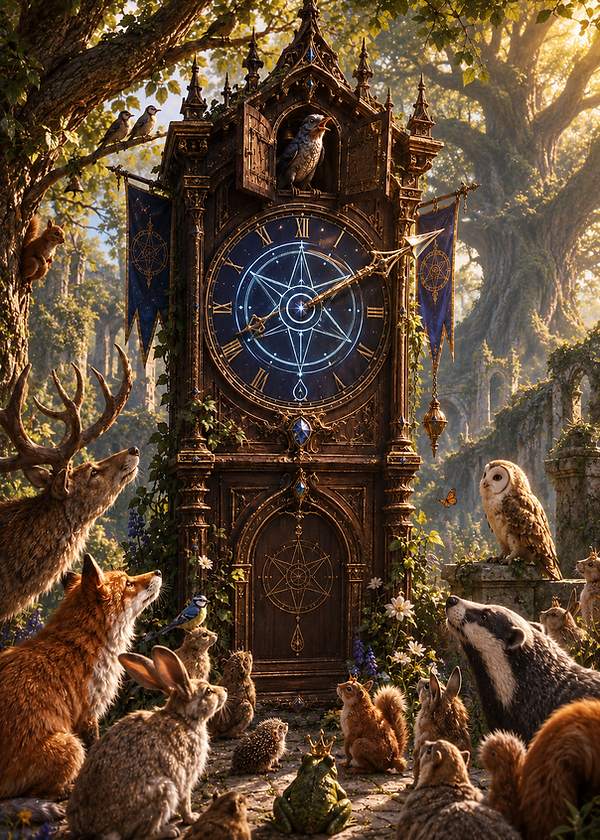
The Reader probably looked at the time.
There was nothing.
Strangely enough, that was disappointing. ✶
✶ Scrivener
There sat a small,
yes,
small,
unsuspecting, silent clerk
at a small, submissive desk
beside a gigantic desk
at the end
of a far too long hallway.
He seemed submissive.
That was probably wise.
—
No one knew for whom he wrote.
He himself said
he did not know either.
Then, from his mouse-like existence,
he looked up for a moment,
high above the desk
beside him.
The high desk
that got everything done
more easily.
“I dare to dream a great deal,”
he said softly.
“But not that high.”
—
Before him lay stacks of paper.
Some were empty.
Some were written on.
And some pretended to be empty,
which, according to the miserable clerk,
was the most dangerous kind of paper.
—
The Traveler stopped before the desk.
“Are you the Writer?”
The clerk did not look up.
“NO.”
His quill kept scratching.
“I only write down
what is too important
to keep existing out loud.”
—
The Mirror bent over a sheet of paper.
“My name is there.”
“Correct,” said the clerk.
The Shadow glided closer.
“Mine is there too.”
“That is also correct.”
The Traveler looked at the final sheet.
There was nothing on it.
Or almost nothing.
Only one sentence:
He thought he had not yet begun.
—
The Traveler swallowed.
“Is that about me?”
The clerk did not smile.
He dipped his quill back
into the ink.
“That depends
on whether you walk on.”
—
Then he wrote one word
at the bottom of the page.
Scrivener.
And somewhere in the hallway
a door
very carefully
became a chapter.
✶
Clerk:
a silent figure who preserves, organizes, and writes down texts.

✶ About the Author
There are writers who tell a story.
There are also writers who explain the story afterwards.
The author of Verenis seemed to have little interest in that.
He preferred to write something down that made the explanation itself begin to doubt.
That was clumsy.
For the explanation.
Not for him.
✶
Some call Verenis a fairy tale.
To others, a myth.
A few called it philosophy.
That was not confirmed.
But not denied either.
That saved another discussion.
✶
The humor is perhaps the strangest thing.
Normally, a joke makes things a little less serious.
In Verenis, the opposite sometimes happens.
Only later do you notice that the joke has subtly diminished somewhat.
Usually your certainty.
✶
Moreover, the story performs a curious experiment.
It treats the reader as if he has been walking around Verenis much longer than he realizes.
That is absurd, of course.
Probably.
✶
Critics might call this meta.
The story itself prefers to call it arousing curiosity.
That sounds friendlier.
And moreover, “meta” reads as if someone forgot to finish the sentence.
✶
Perhaps that is ultimately the most special thing about Verenis.
Not that it is trying to break the fourth wall.
But that it occasionally wonders whether that wall was ever there at all.
At that moment, a frog came hopping along.
He looked at you with striking attention.
Or maybe you were the only one who thought that.
After all, it was just an ordinary frog…?
“Quack.”
…
Quack? thought the reader.
Then he dived into the water.
And he was rarely seen anymore.
At that moment, a house of cards collapsed somewhere.
Coincidence, probably.
Unless it was the reader's.
Or was it perhaps your own reflection…
…that after this fragment he could no longer believe his eyes.
That would explain a lot.
And at the same time, absolutely nothing.
✶
Over de Schrijver – Deel III:
Nu zijn we weer bloed serieus Reiziger:
Er bestaan schrijvers die een verhaal vertellen.
Er bestaan ook schrijvers die het verhaal daarna uitleggen.
De schrijver van Verenis leek daar weinig belangstelling voor te hebben.
Hij schreef liever iets op waardoor de uitleg zelf begon te twijfelen.
Dat was onhandig.
Voor de uitleg.
Niet voor hem.
✶
Sommigen noemen Verenis een sprookje.
Anderen een mythe.
Een enkeling noemde het filosofie.
Dat werd niet bevestigd.
Maar ook niet ontkend.
Dat scheelde weer een discussie.
✶
De humor is misschien het vreemdste.
Normaal maakt een grap iets minder serieus.
In Verenis gebeurt soms het tegenovergestelde.
Pas later merk je dat de grap ongemerkt iets heeft afgenomen.
Meestal je zekerheid.
✶
Het verhaal doet bovendien een merkwaardig experiment.
Het behandelt de lezer alsof die al veel langer in Verenis rondloopt dan hij zelf doorheeft.
Dat is natuurlijk absurd.
Waarschijnlijk.
✶
Critici zouden dit meta kunnen noemen.
Het verhaal zelf noemt het liever nieuwsgierigheid wekken.
Dat klinkt vriendelijker.
En bovendien leest “meta” alsof iemand vergeten is de zin af te maken.
✶
Misschien is dat uiteindelijk het meest bijzondere aan Verenis.
Niet dat het de vierde muur probeert te doorbreken.
Maar dat het zich af en toe afvraagt of die muur er ooit wel is geweest.
Op dat moment kwam er een kikker aangehupt.
Hij keek je opvallend aandachtig aan.
Of misschien dacht je dat alleen.
Het was tenslotte maar een doodnormale kikker…?
“Kwaak.”
…
Kwaak? dacht de lezer.
Daarna dook hij het water in.
En werd hij nog maar zelden gezien.
Op dat moment viel ergens een kaartenhuis om.
Toeval, waarschijnlijk.
Tenzij het dat van de lezer was.
Of was het misschien wel je eigen spiegelbeeld…
…dat na dit fragment zijn ogen niet meer kon geloven.
Dat zou een hoop verklaren.
En tegelijkertijd helemaal niets.
✶
✶
The Bird and the Clock II
So the clock and the frog were suspicious.
Not because the clock predicted the end or beginning of Eternity.
But because she came from there.
While the clock moved backward through time,
she searched for the same vibration
with which everything would one day end or begin.
And where that resonance
touched the present,
Orbi... began to arise.
The Writer could have explained here
what that meant exactly.
But he thought it was important
that the reader first sat uncomfortably
with half a word...
That seemed useful to him.
Especially for the reader.
Not as a voice.
Not as a body.
But as the silent pull
of an ending
that already remembered itself.
✶
In other words:
the clock does not show you directly
what waits at the end of Eternity.
She makes you feel it.
Listen.
And shiver when the moment of Orbi...
begins to appear.
Because what you feel
does not come from the present.
It comes from Eternis.
✶
From this moment on,
Orbi...
will return in other fragments.
You do not have to understand me completely
to feel what is coming.
I will not speak.
I will pull.
And perhaps that is enough
to lead you further,
dear Traveler.
✶
— Orbi...

When you think
that you can stop…
then don't listen to me.
Feel only
why you aren't leaving yet.
✶
— Orbi...

✶
After a long silence…
…a duck crossed somewhere in the distance.
No one knew why.
The duck itself probably didn't either.
That brought unexpectedly much peace for both of them.
🦆
Until...
✶

✶
The reader decided for a brief moment to stop looking for meaning in anything.
That lasted about seven seconds.
Probably a personal record.
✶
✶The Reflection and the Cast Shadow
The Reflection and the Cast Shadow belonged to the same Traveler.
—
They were, naturally, opposites.
—
The Reflection appeared in puddles, windows,
still water,
and polished stone.
He loved light.
Possibility.
Everything that seemed to point forward.
And his own reflection.
That is why he was called Mirror.
—
Whenever the Traveler passed a clear surface,
the Reflection lingered just a little longer.
“Look at me,” he often said.
“So sharp. So clear. So elegant.”
—
The Traveler’s Cast Shadow was alive too.
From the ground, he sighed.
“One day, that puddle will dry.”
The Reflection rolled his eyes.
“Can you say one cheerful thing?”
“One day, everything ends.”
The Cast Shadow looked at him teasingly.
“Cuckoo.”
—
Mirror shivered.
“Stop.”
—
That was usually how it went.
For convenience, we call him Shadow.
—
When the Traveler met a friend, Mirror said:
“Look how loved he is.”
And Shadow answered:
“That only makes goodbye more painful.”
—
When the Traveler succeeded at something, Mirror said:
“See? He is becoming something.”
And Shadow answered:
“Then he has further to fall.”
—
Then, of all things, the tallest tree fell.
Not because it was weak.
But because it had caught too much wind.
—
“See?” said Shadow.
“That is how we end too
if we stick our neck out too far, Mirror.
The Traveler should stay in the shade.”
—
The Reflection looked at him in disbelief.
He pointed at the fallen tree.
“But you cannot both
stay safe like a houseplant
and want to grow tall like a tree.”
—
If you now think this will become important later in the story…
you are probably right.
Or not.
That is exactly what makes it so annoying.
✶
CRITICAL DAMAGE.
—
One day, the Traveler grew tired of their arguing.
—
He went to an old owl
—
who sat in the highest tree.
—
The owl listened.
—
For a long time.
—
Owls are good at that.
—
Then he looked at the Reflection.
—
“Why do you admire yourself so often?”
—
The Reflection smiled far too optimistically.
—
“Because I show the truth.”
—
The Cast Shadow burst out laughing.
—
The Traveler tried to hold his own laughter in.
—
Even the owl seemed to hide a grin for a moment.
—
But he said nothing.
—
Then Mirror snapped at Shadow.
—
“And why do you always expect the worst?”
The Cast Shadow was silent.
Longer than usual.
—
At last, he said:
“Someone has to remember
that light also casts shadows.”
—
Mirror began to laugh.
—
But the owl opened one eye at him.
Mirror closed his mouth.
—
“Those who stare too long at brightness,” said the owl to Mirror,
“begin to fear the crack.”
—
At that very moment,
—
a thin crack appeared
—
in the mirror-smooth ice beside them.
Mirror shivered.
“From the cold,” he said quickly.
Nobody asked anything.
—
Then the owl turned to the Cast Shadow.
“And those who look too closely at loss
begin to hear every step break.”
—
At that moment, somewhere behind them,
—
a small twig snapped.
—
Not loudly.
—
Not importantly.
—
But the Cast Shadow turned around
as if something much larger had fallen.
—
Now they were both silent.
—
For once.
—
Beneath all their arguing,
—
something had been hidden.
Fear.
—
Since that day, they still argued.
—
Of course they did.
—
But a little more softly.
—
Because now and then,
they caught themselves
protecting the same thing.
—
The Traveler’s heart.
—
✶
—
The Reflection fears the crack
where nothing has broken.
—
The Cast Shadow fears the wound
that was never struck.
—
And both call their fear
very wisely
—
wisdom.
—
✶

**Verenis can seem motionless.
Yet even now,
after an eternity,
something is beginning to appear.**

✶ The Crow and the Owl
One evening, when the moon hung like a pale coin above the water, a crow and a barn owl came together at a graveyard that had been slowly swallowed by the water.
Only the tallest gravestones still protruded just above the surface, like silent reminders of names no one spoke anymore. The graves carried more than bodies; they also carried secrets that had never been spoken aloud.
The barn owl landed on one of those stones.
“You have flown a long way,” he said.
“What did you see?”
“Depth,” he said.
How deep?
The crow looked at the dark water.
Deeper than what you still want to know.
Above them hung clouds that had wept a little too much, as if they had not known their own limits. The water below carried that sorrow onward, without asking where it should stop.
The barn owl blinked slowly.
“Tell me.”
The crow was silent.
"Why not?"
The crow looked to the side, at the owl.
Because some things persist as soon as you hear them.
The wind swept across the water. For a moment, the gravestones seemed not to be fixed, but to float in memory.
“Are you afraid that I can’t carry it?” asked the owl.
“No,” said the crow.
That's not it.
“What then?”
The crow looked at the water between them.
That you can't put it down anymore.
Silence.
The moon moved higher.
The owl closed its eyes for a moment.
“And you?” he asked.
The crow did not answer immediately.
When:
If I tell everything, there will be nothing left to keep you afloat.
He spread his wings.
And when he ascended, the moonlight broke in the water — as if the world could not decide for itself where it belonged for a moment.
Beneath the surface, something remained behind in the form of a shadow of wings.
The owl looked at it.
Long.
Without knowing if he had lost anything.
Or had kept exactly enough.
as if he hadn't lost something,
but something was saved.
And somewhere in the water, something remained behind that touched him softly.
Something that looked like love.
Critical Damage...

Passend nummer
✶ The Crow and the Barn Owl – Part II
The crow returned without haste, but also without rest.
He had seen something in the forest that he did not want to carry as words.
The barn owl's nest had been there.
Until a bird of prey came, and silenced everything.
But when he wanted to fly away, he saw something that wasn't right.
A second tree.
Near.
And in it, miraculously, the same kind of nest that you couldn't distinguish.
As if loss and preservation could not exclude each other, but could only exist side by side.
The crow didn't say it immediately.
The owl was still sitting on the stone.
“And?” asked the owl.
The crow looked at the water that still touched the edge of the world.
“Not everything that disappears is gone,” he said softly.
The owl closed its eyes.
And somewhere, the world continued to exist in two forms simultaneously.
✶ The Crow and the Owl – Part III
The crow returned to the stone where the owl sat.
But he didn't land.
The space between them seemed fuller than before, as if something had lingered there that did not want to choose a form.
“You saw something,” said the owl softly.
The crow did not answer immediately.
Beneath them, the water moved slowly, as if it were listening without joining in the conversation.
“The nest,” asked the owl, “is gone?”
The crow barely nodded.
"Yes."
Silence.
The moon hung lower than before.
“A bird of prey,” said the owl, as if he had somehow already known.
The crow took its gaze away from him.
“Yes,” he said.
The owl was silent for a moment, not impatient, simply present.
“Who was it?” he finally asked.
The crow inhaled, but did not let go immediately.
And then he didn't say it.
Not because it wasn't true.
But because it was no longer something that could be shared without breaking something else.
“I don’t remember,” said the crow softly.
The owl nodded slowly.
As if that was enough.
As if that was all an answer ever needed to be.
The crow did not spread its wings.
He held them close to him, as if they had become heavier.
“It is over,” said the owl finally.
“Yes,” said the crow.
And he said it again, alone to himself, where no one could hear it.
Beneath them, the water continued to move.
And somewhere in the forest stood a nest that was never mentioned again.
Later, he would learn
that the best liars
often have the clearest eyes.
The owl looked no further.
The crow carried it alone.
With a full belly
of emptiness and silence.
—
Crows are not birds of prey, are they?
Some parts of Verenis are not meant to be read in silence alone.
1
Menu is helemaal onderaan deze pagina.
If the Music does not play correctly use this link:
✶ The Garden Without a Map
One evening, a red fox found the entrance to the garden.
She was curious.
Perhaps like you,
Fortunately, most wonders begin
exactly there.
A glowing white hare or rabbit.
Not merely white.
But as though moonlight had been given a body
and had suddenly decided to run away.
The hare looked at her for a moment.
As though it wanted to make sure
she had truly arrived.
Then it shot away.
The red fox gave chase.
Between roots.
Under branches.
Along softly glowing streams.
But no matter how fast she ran,
the hare remained just ahead of her.
Until it suddenly disappeared.
It did not fade.
It did not dim.
It disappeared.
As though the light
had stepped out of the world
without leaving a door behind.
The red fox stopped, panting.
Confused.
She looked around.
And then she saw apples.
High above her hung an ancient branch
full of poisonous green apples.
Almost glowing.
Polished.
As though someone had polished them every night
with something not entirely innocent.
Their skins shone like little mirrors.
The fox swallowed again.
She jumped.
And missed.
She jumped again.
And again.
Each time higher.
Each time harder.
But whenever she came close,
the apples seemed
to hang just a little higher.
Not enough to prove
that the tree had moved.
Only enough
to make the fox try again.
At last, she sank down beneath the tree,
with something sour twisting inside her.
The leaves above her rustled softly.
As though the garden were smiling.
For deep down, the fox knew...
that it was not the apples
that had tasted sour.
Her pride.
Though her foxlike nature would never admit it.
And sometimes we call something sour
so we do not have to say
that it touched us.
Then, somewhere farther away,
a strange sound rang out.
Not a roar.
Not a howl.
But the scraping of gold.
The fox pricked up her ears
and followed the sound.
There, between two endlessly tall oaks
whose crowns disappeared into the sky,
stood a powerful horse
made of polished gold,
as though sunlight had been given muscles.
It did not look like an ordinary animal,
nor like a statue.
But something in between.
Something too proud to ask for help
and too alive to remain still.
The horse was tangled
in a net of roots, vines, and sharp silver wire.
The harder it pulled,
the tighter the net became.
His strength did not help him.
His beauty did not help him.
His pride certainly did not help him.
The fox came closer.
“You are stuck,” she said.
The horse looked at her.
“I am resting.”
The fox looked at the roots around his legs.
“Very convincing.”
The horse said nothing.
The fox tried to loosen the knots.
But the roots moved with her.
The silver wire cut deeper.
The net tightened.
Then the grass rustled.
Rats emerged from the darkness.
First one.
Then five.
Then dozens.
Perhaps hundreds.
The golden horse looked down.
The fox startled for a moment
and frowned at the rats.
They set to work.
Tooth by tooth.
Wire by wire.
Knot by knot.
They did not bite out of anger.
Nor out of hunger.
But with a strange, silent precision.
As though they knew
that some things can only be loosened
by beginning small.
Slowly, the net fell apart.
The roots withdrew.
The silver wire snapped.
And the golden horse stood free.
For a long time, no one said anything.
Even the endless oaks seemed to be listening.
Then the horse bowed his head.
Not deeply.
He was too proud for that.
But deeply enough.
The rats disappeared back into the darkness.
Then, from the trunk
of one of the endlessly tall oaks,
came a soft, mechanical tick.
Then, very briefly:
“Cuckoo.”
The fox looked up.
The golden horse raised his head.
Not his animal head.
His head.
The horse looked sternly at the reader for a moment.
“We are not in a meadow,” it said.
The writer paused.
A meadow, in case anyone wondered, is an open field where cows graze.
Graze.
Not grace.
Although the horse clearly believed he possessed plenty of that too.
In the bark of the oak,
a small clock hand began to turn.
Slowly.
As though it were remembering
where it was meant to point.
Eventually, it pointed toward a place
between the roots.
There, a door appeared.
No one had seen it there before.
The fox looked at the horse.
The horse looked at the door.
And somewhere far away,
between the bushes,
a white light seemed to flicker for a moment.
“What lies behind it?” asked the horse and the fox at the same time.
The fox stepped forward.
But this time,
she did not try to grasp anything.
To possess anything.
To prove anything.
The writer looked sternly at the reader.
“Yes,” he said.
“You too.”
The surface of the door was dark and smooth.
It gave back the ancient oaks.
It gave back the golden horse.
It even gave back the faint moonlight
between the branches.
But strangely, it did not give back the fox.
She noticed.
She said nothing.
Then she opened it.
What she saw,
she never told anyone.
Except, perhaps,
one single Traveler.
But that would happen much later.
And probably not honestly at first.
For foxes rarely tell the truth
without first bending it around a corner.
And if the truth tastes sour,
they will usually blame the apple.
The golden horse later disappeared among the hills,
where the evening continued to gleam upon his golden skin
as though glory had not yet finished leaving him.
The rats returned
to the dark corners of their existence,
while the golden horse stood gleaming
in a glory that was not entirely his own.
And the fox was never seen
in quite the same way again.
She had become truly beautiful
in the way dangerous things sometimes are:
not asking to be followed,
yet impossible not to notice.
Almost too beautiful to be true.
The kind of beautiful
that makes you wonder
whether something can be too wondrous
to be true —
and then fear
that it might be true after all.
Which, in the Garden Without a Map,
usually meant it was.
“That,” said the majestic golden horse,
“is exactly the sort of sentence
that gets people eaten by doors.”
And somewhere,
between the path and the one who wrote it,
a new world almost appeared.
Or perhaps only a word.
In Verenis,
the difference was rarely clear.
A little figure walked past.
Backwards.
Not away from them,
but backwards through time.
It looked over its shoulder
and whispered:
“Orbi…”
Then it was gone
before it had ever arrived.
The writer, being unhelpful on purpose, added:
Some say she eventually found the apples.
Others say she discovered
that she had never truly
been searching for apples.
But the oldest stories say something else.
They say the garden had been guiding her
from the moment she saw the glowing hare or rabbit.
The reader, naturally,
was not supposed to notice
that the same thing had been happening to them.
And somewhere,
between the path and the one who wrote it,
a word waited.
Not to be understood yet.
Only to arrive
when the time had learned its name.
Orbi...
Perhaps none of those encounters had been coincidence.
Perhaps the garden had not shown her the way all at once,
but only one wonder at a time.
The following night,
one of the poisonous green apples
had turned red.
Strangely red.
Polished.
Perfect.
As though it had been waiting
for the fox to stop wanting it.
And perhaps,
though the reader would deny this,
it had been waiting for them too.
No one knew excacly why.
The oldest stories do not yet reveal
what lay behind the door.
Perhaps because the story was never truly
about the hare.
Or the apples.
Or the golden horse.
Or even the fox.
And perhaps another figure
has only just arrived.
Perhaps you are that figure,
a Traveler
in the Garden Without a Map.
✶
Verenis resembles a collection of doors
that have appeared over time.
Some visitors open one.
Some open all of them.
“Ambitious,” whispered the golden horse.
“Almost respectable.”
Some stare at the first door
for several minutes,
then decide they were probably
never a door person to begin with.
Everyone walks their own path
through the garden.
Perhaps that is exactly
as it should be.
✶

Geschilderd door V
You think you are looking for something.
But perhaps the search itself
is what takes you deeper into the garden.
Deeper
than an answer would ever dare,
said the beautiful fox with a soft chuckle.
Then she touched a single string of her harp,
as though she knew the one note
that would strike the reader
where they were easiest to reach.
The writer noticed this.
Worse,
he also noticed
that the reader probably found it charming.
“My name is Veli...”
The golden horse interrupted her
with the confidence of someone
who had never once doubted
that the story was secretly about the horse.
The writer laughed out loud.
Even Solyphis did not know exactly why.
Naturally, he pretended that he did.
Solyphis lifted his head.
“Naturally...,” it continued.
He sounded slightly annoyed.
Which, for Solyphis,
was almost the same as sounding proud.
✶
Then came another stutter of Orbi…
Orbi...
Solyphis interrupted once again,
this time with even greater pride.
He stepped forward with great dignity.
“My name,” he said,
“is not Orbi......”
this time he sounded insulted.
The writer sighed.
The reader sighed.
Solyphis ignored this entirely.
“My name is Solyphis,” he said,
“the majestic golden horse.”
Somewhere in the garden,
whatever the f…Orbi…was,
tried very hard not to laugh.
For a moment, no one moved.
Then Solyphis made a strange horse-like sound.
Not quite a neigh.
Not quite a cough.
Something in between.
As though he had tried to sound mysterious,
but had accidentally started horsing around.
Orbi…
The unfinished word seemed to continue.
“You will understand, in the end,
why Solyphis suddenly had majestic wings.”
He looked deeply annoyed.
“Suddenly?” he said, indignant.
Even time itself began to stutter.
Then, somehow, to chuckle.
It was the softest laugh
in the Garden Without a Map,
and somehow
the loudest.


Solyphis

Veli...
Orbi...
✶
Niemand wist precies wat er zojuist was gebeurd.
Dat was opvallend democratisch.
✶

Some things do not become precious at once.
They are shaped slowly,
hidden from sight,
until time gives them their glow.
Like wine.
Like a pearl.
Like Solyphis.
Solyphis looked deeply offended.
“I was not shaped slowly,” he said.
“I arrived complete.”


Healintis Symbol
.png)
Welcome in Healintis
A symbolic experience you enter through image, sound, and recognition.

You can best experience Verenis on a PC or laptop.



Open


